Food Defense and Physical Security Under the IA Rule

Food Defense and Physical Security Under the IA Rule
Food and beverage manufacturers are navigating three overlapping pressures at once: the FDA’s mandatory Intentional Adulteration Rule, GFSI certifications such as SQF or BRCGS, and demanding customer audits.
In some cases, the situation is further challenged by the fact that food defense programs are led by food quality and safety yet requires substantial physical security coordination to be fully effective. Facilities are also discovering that strong GFSI audit scores do not automatically translate into strong IA Rule readiness or robust protection against intentional acts.
The difference often comes down these factors: how well “food defense” is coordinated against all three factors described above AND supported by sound physical security practices and expertise.
Food Safety Versus Food Defense
What is Food Safety?
Food safety protects against accidental contamination. It relies on HACCP, GMPs, and process controls.
What is Food Defense?
Food defense protects against intentional adulteration. Food defense in the US, as framed by FDA’s Intentional Adulteration Rule, is focused on preventing intentional adulteration from acts intended to cause wide-scale public health harm, including acts of terrorism targeting the food supply.
In practical physical security terms, however, the food defense mindset also requires consideration of broader adversarial motivations, including harm, extortion, ideology, coercion, and insider grievances. These threats require a different mindset than traditional food safety: assessing access and intent, applying physical security principles, and maintaining ongoing vigilance.
The Common Gap in Today’s Food Safety and Quality Programs
Traditional food safety and quality teams are excellent at what they do. However, many were not trained in physical access control, insider threat detection, surveillance response protocols, or behavioral indicators. This creates a common gap. When food defense and physical security are properly coordinated, the program shows these characteristics:
- A true multidisciplinary team that includes physical security expertise (in-house or external).
- Conduct Reality-Based Risk Assessments, not just vulnerability assessments, that includes actionable process steps for access, feasibility, and potential impact (including insider threats) but also addresses the role of physical security in the program and ensures someone on the team knows “what good looks like” for physical security measures that support food defense (e.g., access control, key control, video surveillance, alarm monitoring).
- Practical and verifiable mitigation strategies that layer physical security controls with existing food safety measures.
- Unified documentation. A living Food Defense Plan with clear crosswalks for GFSI and customer audits (in the best case supported by a companion physical security plan).
- A culture of testing and continuous improvement. Meaningful mock audits, challenge testing and tabletop exercises that simulate real FDA inspections, not just GFSI audits or internal drills.
- Training that goes beyond awareness. Role-specific training for Qualified Individuals plus practical security awareness for all staff.
The result is predictable. Facilities pass GFSI audits with high marks but fail key elements of an IA Rule inspection because their vulnerability assessments are incomplete, mitigation strategies lack real security depth, management controls are not clearly defined, assigned, documented, reviewed, or verified, training is insufficient, and records are incomplete.
What Well-Coordinated Food Defense + Physical Security Looks Like
When food defense and physical security are properly integrated, the program exhibits several clear characteristics:
A True Multidisciplinary Team
The food defense team includes not only quality, operations, and maintenance, but also physical security expertise — either in-house or through a qualified external partner. This team understands both the production process and how an adversary could exploit it.
Risk Assessment Grounded in Reality
Conduct Reality-Based Risk Assessments, not just vulnerability assessments, that include actionable process steps for access, feasibility, and potential impact (including insider threats) but also address the role of physical security in the program and ensures someone on the team knows “what good looks like” for physical security measures that support food defense (e.g., access control, key control, video surveillance, alarm monitoring).
Mitigation Strategies That Are Practical and Verifiable
- Mitigation measures combine traditional food safety controls with physical security layers
- Access control applies to insiders and outsiders where effectiveness can withstand rigorous physical security audit protocols.
- Restricted access zones with proper authentication and monitoring
- Tamper-evident seals and packaging that are inspected
- Realistic surveillance coverage with meaningful review protocols
- Clear management controls that separate monitoring, corrective action, and verification responsibilities
- Insider threat awareness built into hiring, training, and ongoing observation
Unified Documentation That Serves All Audiences
A well-coordinated program maintains a living Food Defense Plan that satisfies the IA Rule while also providing clear crosswalks or appendices for GFSI audits and major customer requirements. Companies that exhibit best in class preparedness would also typically have a physical security plan to accompany and be a close companion to the food defense plan. This eliminates duplication and reduces audit fatigue and is a critical time saver for Food Quality and Safety Team Members who are already overtaxed with duties and paperwork.
Culture of Continuous Improvement and Testing
Reanalysis is not a paperwork exercise — it is triggered by real changes and informed by regular testing. Facilities that traditionally are best prepared conduct meaningful mock audits and tabletop exercises that simulate how an actual FDA inspection would unfold, not just internal drills or GFSI auditing. Staff at every level understand their role in detecting and responding to suspicious activity and what measures are expected day in and day out to comply with written plans and provide meaningful risk reduction, not just compliance.
Training That Goes Beyond Awareness
Qualified Individuals receive role-specific training. While not required by the IA Rule, all employees should also receive practical security awareness training that helps them recognize behavioral red flags without turning the facility into a police state and how to properly work within the physical security framework established to protect a myriad of critical assets.
The Real-World Contrast
Consider a facility that earned a high rating on its BRCGS audit and felt confident heading into an FDA inspection. When an independent review was conducted using IA Rule methodology, significant gaps emerged: incomplete vulnerability assessment, an inaccurate food defense plan, missing or inadequate records, incomplete training documentation, and management controls that were not properly separated or monitored.
This is not unusual. GFSI standards are valuable, but they were not written as a substitute for the specific requirements of 21 CFR Part 121. A well-coordinated program closes this gap by design.
Relevance and Current Context
FDA inspectors have moved beyond “Quick Checks” to full-scope food defense inspections. At the same time, customers and export markets continue to raise expectations. Facilities that treat food defense as an extension of food safety, or as a GFSI checkbox, are increasingly exposed.
The organizations that perform best under scrutiny are those that have deliberately brought physical security expertise into the food defense conversation. They do not view the IA Rule as a burden to be minimally satisfied. They use it as an opportunity to build genuine resilience.
The Six Pillars of Coordinated Food Defense
A strong food defense program is not just a written plan. It depends on the right people, realistic risk assessment, practical physical protections, regular testing, and training that matches each employee’s role. The six pillars below show how BPS approaches coordinated food defense across compliance, operations, and real-world security risk.
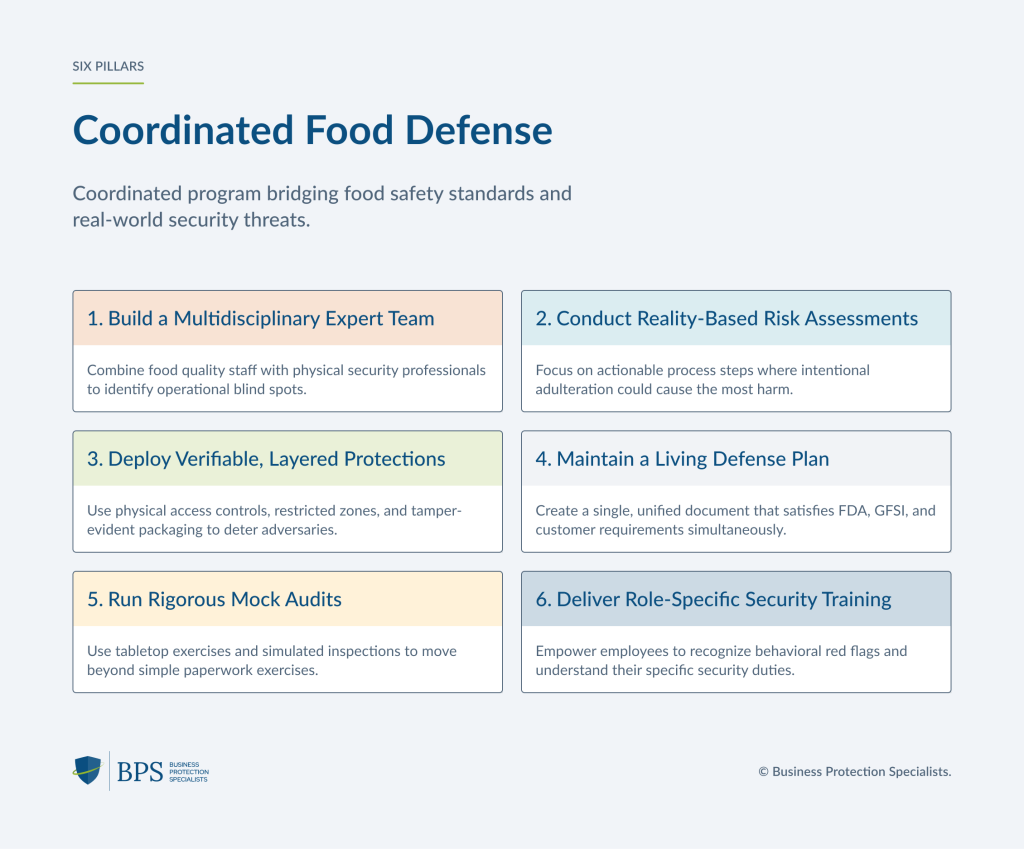
Well-coordinated food defense and physical security is not about adding more paperwork. It is about bringing the right disciplines together, asking the right questions about access and intent, implementing measures that actually work in the real world, and maintaining a living program that evolves with the operation.
If your current food defense program is led exclusively by food safety professionals without meaningful physical security input, the real time protection gaps are almost certainly larger than they appear, especially when measured against the IA Rule inspection expectations.
The facilities that will thrive are those that move from treating food defense as a food safety add-on and start treating it as a true security discipline integrated with production realities. That is what well-coordinated food defense and physical security looks like in practice.
Is Your Food Defense Program Truly IA Rule Ready?
Download our white paper to identify hidden gaps and strengthen FDA inspection readiness.

Frank Pisciotta has spent 36 years in physical security consulting and crime prevention. As President and CEO of Business Protection Specialists, he has led more than 5,000 threat assessment, risk analysis, and security design projects worldwide. Frank is a Certified Security Consultant (CSC) and achieved the Certified Protection Professional (CPP) designation in 1994.